Learn / Purity, karats and hallmarks
Gold colors and alloys, white, rose, green and more
Gold comes in many colors because of the metals mixed into it. Here is what makes white, rose, green and other colored golds, and how each wears over time.
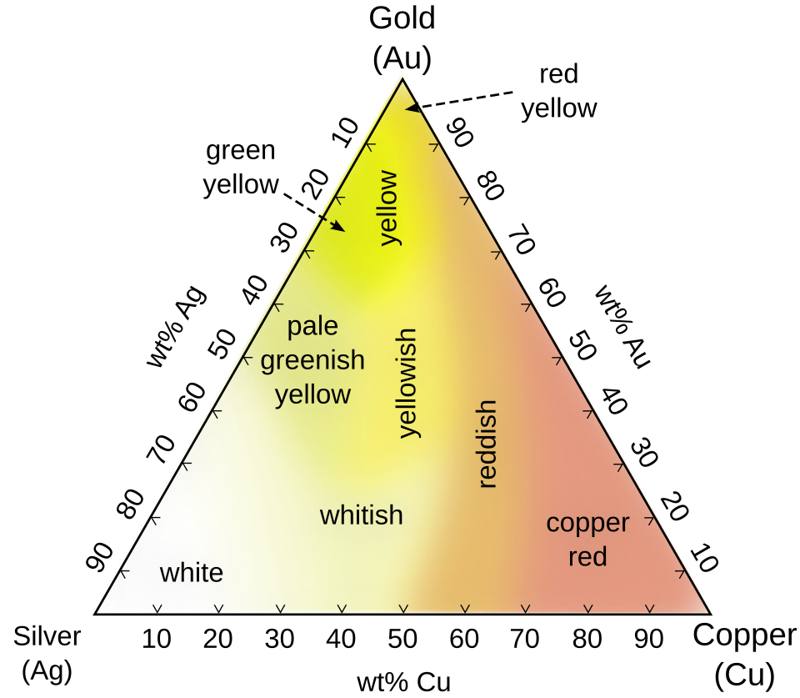
Color comes from the recipe
Pure gold has only one color: rich yellow. Every other "gold color" is an alloy, a mixture of gold with other metals. The two main color levers are silver, which pushes gold toward greenish or paler yellow, and copper, which pushes it toward red. Other metals such as palladium, nickel and zinc whiten it. The karat stays the same as long as the gold proportion stays the same, so an 18K yellow ring and an 18K white ring both contain 75 percent gold.
Yellow gold
Classic yellow gold mixes gold with roughly equal parts silver and copper, sometimes with a touch of zinc. Higher karats look deeper and more saturated; 22K is noticeably richer than 14K. Yellow gold needs no plating and is easy to resize and repair.
White gold
White gold is gold alloyed with white metals, usually palladium or nickel, plus silver or zinc. The result is a pale grayish or slightly yellowish metal, not bright white. To get the bright, mirror-white look sold in stores, most white gold jewelry is plated with rhodium, a hard, bright platinum-group metal.
What to know:
- Rhodium plating wears off over time, especially on rings, revealing the slightly warmer color underneath. Jewelers can re-plate it.
- Nickel white gold is harder and cheaper but can cause skin reactions in people with nickel allergy, which is common. The European Union restricts nickel release from items in prolonged skin contact.
- Palladium white gold is hypoallergenic for most people but more expensive.
Rose, red and pink gold
Adding more copper gives warm tones:
| Name | Approximate 18K recipe | Look |
|---|---|---|
| Pink gold | 75 percent gold, about 20 percent copper, 5 percent silver | Soft pink |
| Rose gold | 75 percent gold, about 22 percent copper, 3 percent silver | Rosy |
| Red gold | 75 percent gold, 25 percent copper | Deep red-gold |
Exact recipes vary between manufacturers. Rose gold was widely used in 19th-century Russia, which is why it is sometimes called Russian gold. Because copper is hard, rose gold is quite durable. Copper can tarnish slightly over time, which some people like as a warm patina.
Green gold
Green gold is gold alloyed mainly with silver, giving a soft greenish-yellow. Natural electrum is a kind of green gold. Some green gold recipes add cadmium to deepen the color, but cadmium is toxic and is now restricted in jewelry in many places, so modern green gold relies on silver and other safer metals.
Unusual colors
- Purple gold: an intermetallic compound of gold and aluminum. It is brittle, so it is used as an inlay or set like a gemstone, not to make whole rings.
- Blue gold: compounds of gold with indium or gallium, also brittle and rarely used.
- Black gold: usually created by surface treatments, such as black rhodium plating or controlled oxidation of cobalt alloys.
Durability compared
| Alloy | Hardness | Upkeep | Allergy notes |
|---|---|---|---|
| Yellow 14K | Good | Polish occasionally | Low risk |
| Yellow 18K | Moderate | Scratches more | Low risk |
| White gold, nickel | High | Re-plate rhodium every year or few years | Nickel allergy risk |
| White gold, palladium | Moderate | Re-plate rhodium as needed | Low risk |
| Rose gold | High | Minimal | Copper sensitivity in rare cases |
Mixing colors
Two-tone and tri-color designs combine yellow, white and rose gold in one piece. Since all three can be the same karat, they can be soldered together.
If you are allergic to nickel, ask whether white gold is nickel-free or choose yellow, rose or palladium-based gold, or platinum.
For how much gold each karat contains, see karats explained. If a piece is gold-colored but much cheaper than expected, it may be plated, explained in plated, filled and vermeil.