What is gold?
Gold is chemical element 79, a dense, soft, yellow metal that stays shiny for thousands of years. Here is what it is made of and why people value it.
Element 79
Gold is a chemical element: a substance made of only one kind of atom. Every gold atom has 79 protons in its nucleus, which is why gold sits at number 79 on the periodic table. Its chemical symbol is Au, from the Latin word aurum.
The only stable form of gold found in nature is gold-197, with 79 protons and 118 neutrons. That makes gold one of the few elements that exists naturally as a single isotope. Its atomic mass is about 196.97.
Gold belongs to a family chemists call transition metals, and it sits in the same column of the periodic table as copper and silver. All three were used as coinage metals for centuries, and all three are excellent conductors of electricity.
A noble metal
Gold is called a noble metal because it barely reacts with anything. Air, water, salt and most acids leave it untouched. Gold coins pulled from shipwrecks after centuries on the seabed can come up looking almost new, while iron objects from the same wreck have turned into lumps of rust. We explain the chemistry in why gold does not rust.
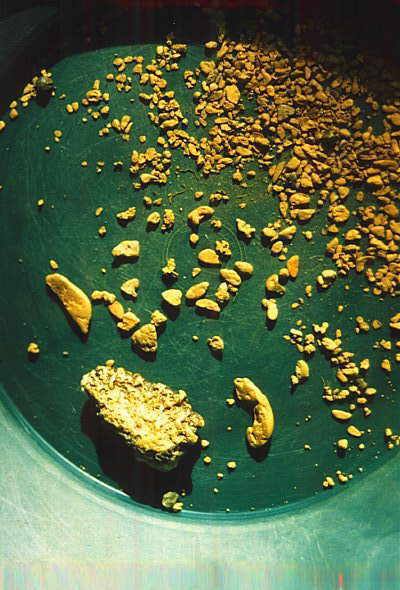
Because it does not react easily, gold is one of the few metals that is often found as a pure metal in nature, called native gold, rather than locked inside a chemical compound. That is a big reason it was one of the first metals people ever worked.
What gold looks like
Pure gold is a warm, bright yellow. Most metals look silvery because they reflect all colors of visible light about equally. Gold absorbs some blue light and reflects the rest, so it looks yellow. Physicists trace this to relativistic effects: the inner electrons of such a heavy atom move so fast that Einstein's relativity shifts the energy levels of the outer electrons. Without relativity, gold would look silvery.
Natural gold is rarely 100 percent pure. Nuggets and flakes usually contain some silver and a little copper. Many nuggets are somewhere between about 70 and 95 percent gold, with the rest mostly silver, which lightens the color. A natural gold and silver mix with a high silver content is called electrum, the metal of the very first coins (see the first gold coins).
Key numbers at a glance
| Property | Value |
|---|---|
| Symbol | Au |
| Atomic number | 79 |
| Atomic mass | about 196.97 |
| Density | about 19.3 grams per cubic centimeter |
| Melting point | about 1,064 C (1,948 F) |
| Hardness | 2.5 to 3 on the Mohs scale |
| Natural isotopes | one stable isotope, gold-197 |
A cube of pure gold measuring 10 centimeters on each side (about the size of a large orange) weighs about 19.3 kilograms, more than 42 pounds. That surprising weight is one of the easiest ways to understand gold. More numbers live in the properties of gold.
Why people value it
Gold has been valued by almost every culture that found it, for practical reasons:
- It lasts. It does not tarnish, rust or rot, so a gold object made thousands of years ago can still shine.
- It is rare. All the gold ever mined would fit in a cube roughly 22 meters on each side. See how much gold exists.
- It is easy to work. It can be hammered, drawn into wire and cast with simple tools, and it can be melted and reused again and again.
- It is beautiful. Its color is unlike any other common metal.
- It is recognizable. Its weight, color and softness make it hard to confuse with most other materials.
Today a little under half of all above-ground gold is in jewelry, and the rest is split between private investors, central banks and industry. Keep reading through Gold basics or jump to the gold glossary.