Why gold does not rust or tarnish
Gold stays shiny because its atoms hold tightly to their electrons and refuse to bond with oxygen. Here is the chemistry, and what can still discolor gold jewelry.
Rust is a chemical reaction
Rust is what happens when iron reacts with oxygen and water to form iron oxides. Silver tarnishes when it reacts with sulfur compounds in the air, forming black silver sulfide. Copper turns green over the years as it forms copper carbonates. All of these changes need the metal to give up electrons to another substance.
Gold simply does not want to do that. Its electrons are held very tightly, so oxygen, water and sulfur have nothing to grab. Chemists say gold has a very high reduction potential, meaning it is far more stable as a metal than as a compound. In practical terms, gold that goes into the ground or the sea comes back out still gold.
The relativity connection
Gold is a heavy atom with 79 protons pulling on its electrons. The innermost electrons move at a large fraction of the speed of light. According to relativity, that makes them behave as if they were heavier, and the outermost electron (in what chemists call the 6s orbital) is pulled closer to the nucleus and held more tightly than it would otherwise be. That same effect gives gold its yellow color. It also helps explain why gold is so reluctant to react.
Proof from history
Some of the most famous gold objects show how well gold survives:
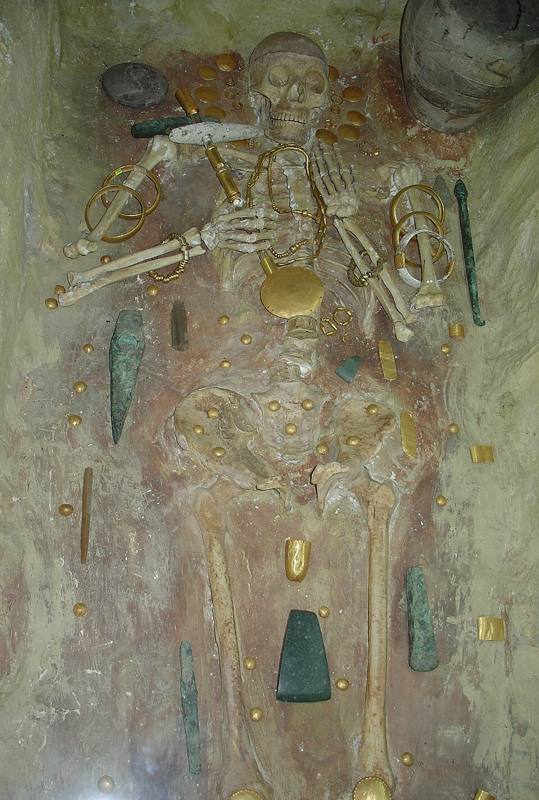
- The Varna gold, from a cemetery near the Black Sea coast of present-day Bulgaria, is dated to roughly 4600 to 4200 BC and is among the oldest worked gold ever found. It is still bright.
- Ancient Egyptian gold, such as the treasures found in the tomb of Tutankhamun in 1922, still gleams after more than 3,300 years. See gold in ancient Egypt.
- Shipwreck coins recovered after centuries underwater often need only gentle cleaning, while iron nails and fittings from the same wrecks are heavily corroded.
Why gold jewelry can still discolor
If gold never tarnishes, why do some gold rings darken or leave a mark on skin? Because most jewelry is not pure gold.
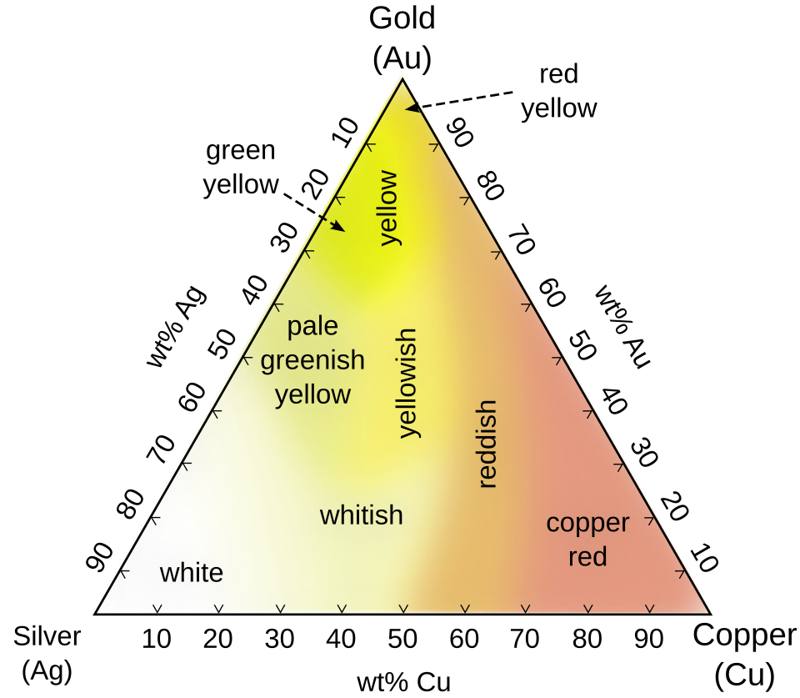
- Alloy metals tarnish. A 14K ring is about 58 percent gold. The rest is mostly silver, copper and sometimes zinc or nickel, and those metals can react with sweat, chlorine and sulfur. Lower karats tarnish more easily. See karats explained.
- Skin marks. Dark or green marks on skin usually come from copper in the alloy reacting with sweat, lotions or cosmetics.
- Plating wears through. Gold-plated items have only a microscopically thin gold layer over another metal. When it wears away, the base metal tarnishes. See plated, filled and vermeil.
- Dirt and oils collect on any ring and dull its shine. Warm water, a drop of mild dish soap and a soft brush usually restore it.
Take gold jewelry off before swimming in chlorinated pools or hot tubs. Chlorine can attack the alloy metals in lower-karat gold over time and weaken solder joints.
What does attack gold
Gold is not completely invulnerable. It dissolves in aqua regia, a mixture of concentrated nitric and hydrochloric acids whose Latin name means "royal water" because it dissolves the royal metal. Cyanide solutions dissolve gold when oxygen is present, which is the basis of most modern gold extraction. Mercury forms an amalgam with gold, a fact used for thousands of years in mining and gilding, and still used, with serious health costs, in small-scale mining today (see environmental impact).
Testing with acid
Jewelers take advantage of gold's resistance with the acid test. They rub the item on a dark touchstone to leave a streak, then apply acids of known strength. Lower-karat gold and base metals dissolve under acids that higher-karat gold can survive, so the streak that remains gives an estimate of purity. It is a quick shop test, not a lab assay; assaying explains the precise methods.
The bottom line
Gold stays shiny because it is chemically lazy. That one property, combined with rarity and beauty, explains why gold became a store of wealth, why it is trusted in electronics and why a gold ring can be passed down for centuries.