The environmental impact of gold mining
Gold mining moves huge amounts of rock and uses toxic chemicals. Here are the main impacts, from mercury and acid drainage to tailings dams, and how responsible mining reduces them.
Why gold has a big footprint
Gold is rare in rock, so mining it means moving and processing a lot of material for a small amount of metal. At a typical large open pit, tonnes of rock are moved for every few grams of gold. That rock has to go somewhere, the gold has to be extracted chemically and the mine site has to be restored afterward. The impacts depend heavily on the deposit, the methods and how well a mine is regulated and run.
Mercury from small-scale mining
Artisanal and small-scale gold mining (ASGM) supports millions of people in more than 70 countries. Many of these miners use mercury to capture gold, then burn the amalgam over open fires. This:
- Exposes miners and families, including children, to toxic mercury vapor
- Releases mercury into rivers, where it can turn into methylmercury and build up in fish
- Makes ASGM the largest single source of human-caused mercury emissions globally, according to the UN Environment Programme
The Minamata Convention on Mercury, an international treaty in force since 2017, requires countries with significant ASGM to develop plans to reduce mercury use. Programs promote mercury-free methods such as better gravity concentration, retorts that capture mercury, and fair-trade or certified schemes that help small miners sell responsibly produced gold.
Mercury vapor is a serious health hazard. Never heat mercury or amalgam, and never use mercury for hobby panning.
Cyanide
Large mines dissolve gold with dilute cyanide (see cyanide and heap leaching). Cyanide breaks down relatively quickly in sunlight and air, but spills can kill fish and wildlife. The 2000 Baia Mare spill in Romania is a well-known example. Strict liners, cyanide destruction, monitoring and the International Cyanide Management Code aim to prevent repeats.
Acid rock drainage
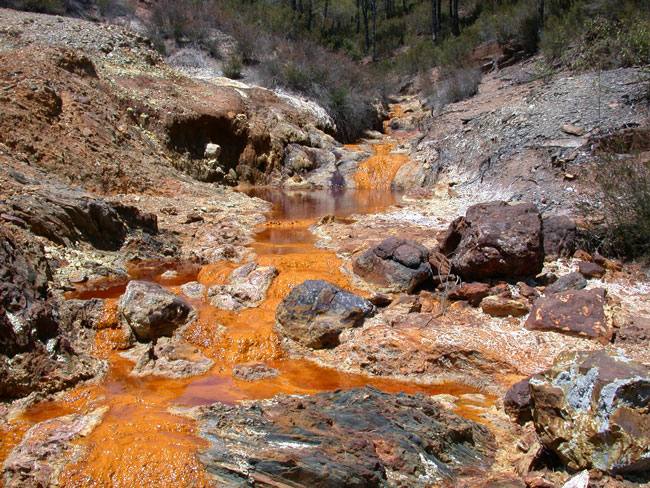
Many gold ores contain sulfide minerals such as pyrite. When waste rock or tailings are exposed to air and water, these minerals oxidize and create sulfuric acid, which dissolves metals like iron, copper, zinc and arsenic. The resulting acid rock drainage (or acid mine drainage) can stain streams orange and harm aquatic life, and at abandoned mines it can continue for decades or centuries. Prevention means covering reactive rock, keeping it underwater or treating the water.
Tailings
Tailings are the finely ground rock left after processing, pumped as a slurry into storage facilities, often behind embankments called tailings dams. A failure can release a flood of mud. After several major tailings failures in the mining industry, a Global Industry Standard on Tailings Management was launched in 2020, setting stronger requirements for design, monitoring and accountability. Many modern operations also filter tailings and stack them dry to reduce risk.
Water, land and energy
- Water: processing uses a lot of water, which matters in dry regions. Many mines recycle most of their process water.
- Land: open pits, waste dumps and roads clear vegetation and habitat. In the Amazon and other rainforest regions, illegal small-scale mining drives deforestation and river pollution.
- Energy and carbon: crushing, grinding and hauling rock use large amounts of energy. Some mines are adding solar, wind and battery-electric equipment to cut emissions.
Historic damage
Older mining left scars that remain. California's 19th-century hydraulic mining buried rivers under debris (see the California gold rush), and many historic mines still leak acid drainage or contain mercury-laden sediments. Cleanup programs in several countries address these legacy sites.
What responsible mining looks like
| Practice | Why it matters |
|---|---|
| Environmental impact assessment before mining | Identifies risks and alternatives |
| Financial bonds for closure | Ensures cleanup is paid for even if a company fails |
| Progressive reclamation | Restores land during mining, not only after |
| Independent audits and reporting | Lets communities and buyers verify claims |
| Community agreements | Gives local and Indigenous communities a voice and a share of benefits |
What you can do as a buyer
- Consider recycled gold, which avoids new mining impacts. See recycling gold.
- Ask jewelers about sourcing and certifications such as Fairmined or Fairtrade gold, or the Responsible Jewellery Council.
- Use our buying gold safely checklist.