Cyanide leaching and heap leaching
Most gold today is dissolved out of crushed rock with a weak cyanide solution, then recovered on activated carbon. Here is how tank and heap leaching work and how cyanide is managed.
Why cyanide
Most gold in modern ore is microscopic. Gravity methods such as panning and sluicing cannot catch grains that small. Chemistry can.
In 1887, John Stewart MacArthur and Robert and William Forrest patented the cyanide process in Scotland. When a dilute solution of sodium cyanide is mixed with crushed ore and oxygen is present, gold dissolves to form a stable gold cyanide complex. The process transformed gold mining, starting with the Witwatersrand, and it remains the main extraction method worldwide.
The solutions used are dilute, typically a few hundred parts per million of cyanide, and kept alkaline (high pH) with lime. Alkalinity is essential for safety, because in acidic conditions cyanide can form highly toxic hydrogen cyanide gas.
Tank leaching
For milled ore, leaching happens in a series of large agitated tanks:
- Ore is ground into a fine slurry with water.
- Lime and cyanide are added, and air or oxygen is bubbled through.
- Gold dissolves over roughly a day or two as the slurry flows from tank to tank.
- Activated carbon, made from coconut shells, is added to soak up the dissolved gold.
When the carbon is added in the same tanks as leaching, it is called carbon-in-leach (CIL). When leaching happens first and carbon is added in later tanks, it is carbon-in-pulp (CIP). Screens keep the coarse carbon granules in each tank while slurry flows on, and loaded carbon is pumped counter-current toward the first tank.
Getting gold off the carbon
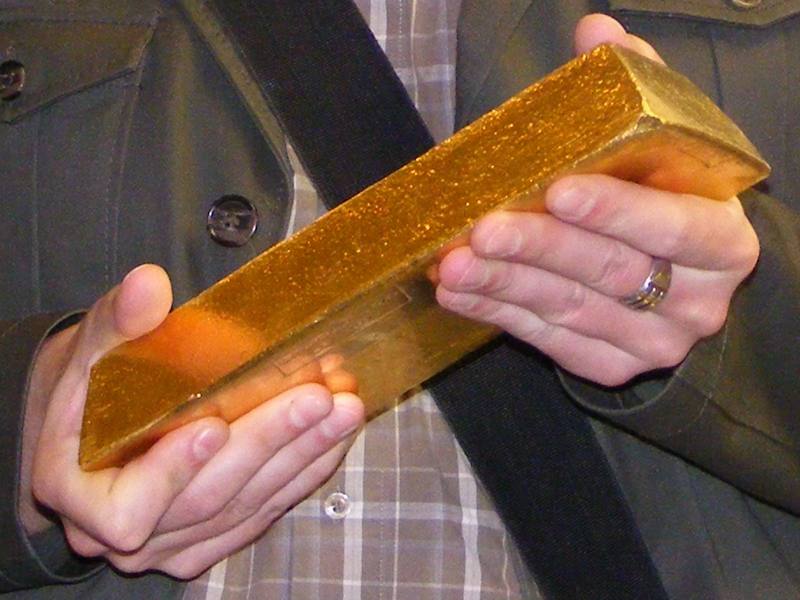
The gold-loaded carbon goes to an elution circuit, where hot caustic cyanide solution strips the gold back into a small volume of strong solution. Gold is then recovered by electrowinning, plating it onto steel wool cathodes, and the carbon is reactivated in a kiln and reused. The gold sludge is smelted into dore bars. See smelting and refining.
An older alternative is the Merrill-Crowe process, which adds zinc dust to a clear gold-bearing solution so gold precipitates out. It is still used at some mines, especially where ore contains a lot of silver.
Heap leaching
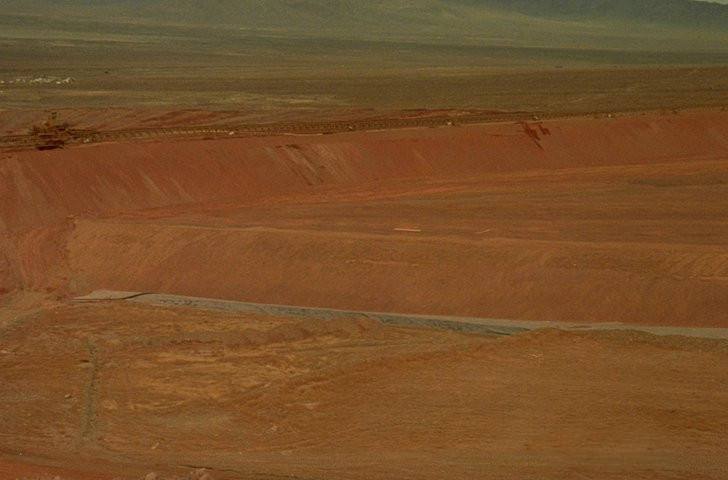
For very low-grade ore, grinding is too expensive. Heap leaching skips the mill:
- Ore is crushed coarsely, or used straight from the pit (run-of-mine).
- It is stacked in large heaps on a lined pad, with plastic liners and clay layers below to stop leaks.
- Drip lines or sprinklers apply dilute cyanide solution to the top.
- Solution trickles through the heap over weeks to months, dissolving gold.
- The "pregnant" solution drains to collection ponds and goes through carbon columns.
- Barren solution is topped up with cyanide and recirculated.
Heap leaching recovers a smaller percentage of the gold than milling, but it is much cheaper per tonne, so it can make very low-grade deposits viable. It is widely used in places such as Nevada and in parts of South America and West Africa.
Comparing the options
| Method | Ore type | Typical recovery | Cost per tonne |
|---|---|---|---|
| Gravity only | Coarse free gold | Variable | Low |
| Tank leach (CIL/CIP) | Ground ore, higher grade | Often 90 percent or more | Higher |
| Heap leach | Low-grade crushed or run-of-mine ore | Often 50 to 80 percent | Low |
| Pre-oxidation plus leach | Refractory sulfide ore | Varies | Highest |
Managing cyanide
Cyanide is toxic, so its use is tightly controlled. Good practice includes:
- Keeping solutions alkaline to prevent hydrogen cyanide gas
- Double liners and leak detection under pads and ponds
- Cyanide destruction circuits that break down residual cyanide before tailings are stored
- Bird and wildlife protection over open solution ponds
- Monitoring of ground and surface water
Many large mines sign the International Cyanide Management Code, a voluntary industry program with independent audits covering transport, storage, use and emergency response.
Accidents have happened. In 2000, a tailings dam failure at Baia Mare in Romania released cyanide-contaminated water into rivers, killing large numbers of fish downstream. Events like this drove stricter rules. See environmental impact.
Alternatives
Researchers and some mines use or test alternatives such as thiosulfate leaching, glycine-based systems and improved gravity and flotation circuits. Cyanide remains dominant because it is effective, well understood and breaks down in sunlight and air, but alternatives are growing for special ores.