Gold in ancient Egypt
Ancient Egypt mined gold on a scale no earlier civilization matched, drew one of the oldest known geological maps of a gold mining area and created goldwork that still shines today.
A land rich in gold
Ancient Egypt had access to some of the richest gold sources of the ancient world. Most of it came from the Eastern Desert, the rugged strip of mountains between the Nile and the Red Sea, and from Nubia, the region to the south along the Nile in what is now southern Egypt and northern Sudan. Egyptian rulers organized mining expeditions there over many centuries, and gold from these regions flowed into workshops along the Nile.
Gold was so tied to wealth and status that later Egyptian rulers of other states wrote letters asking Egypt's kings for gold, describing it as being as plentiful as dust in Egypt. Gold gifts were part of diplomacy between the great powers of the Late Bronze Age.
How Egyptians mined gold
Egyptian miners worked both placer gravels in dry riverbeds (called wadis) and hard-rock quartz veins.
- Workers broke quartz vein rock with stone hammers and, later, metal tools, sometimes heating the rock with fire to crack it.
- The broken rock was crushed with stone mortars and ground on hand mills into fine powder.
- The powder was washed on sloping stone tables with water so the light quartz washed away and the heavy gold stayed behind.
- The gold dust was melted in clay crucibles over charcoal fires, with workers blowing air through reed pipes and, later, using foot bellows to reach high temperatures.
Water was scarce in the desert, so washing gold was a major challenge. Ancient writers and modern archaeologists describe hard working conditions in these desert mines.
The oldest geological map
The Turin Papyrus Map, drawn around 1160 BC, is one of the oldest surviving maps of its kind. It shows a stretch of the Wadi Hammamat in the Eastern Desert, with roads, quarries, a gold mining settlement and hills colored to show different rock types. Because it records where different rocks and a gold working area were located, it is often called the world's oldest known geological map. It is kept at the Egyptian Museum in Turin, Italy.
Goldsmiths and their techniques
Egyptian goldsmiths mastered techniques that jewelers still use:
- Casting molten gold in molds
- Hammering gold into thin sheets and foil
- Granulation, fusing tiny gold beads onto a surface
- Inlay, setting colored stones and glass into gold cells
- Gilding, covering wood and other materials with gold leaf
They also made gold alloys with different colors by mixing in silver or copper. See gold colors and alloys.
The tomb of Tutankhamun
The most famous Egyptian gold was found in 1922, when archaeologist Howard Carter's team uncovered the nearly intact tomb of the young king Tutankhamun in the Valley of the Kings. Among thousands of objects were the famous gold mask, which contains about 10 kilograms of gold, and an innermost coffin made of solid gold weighing more than 100 kilograms. These objects date to the 14th century BC and are among the best-known artifacts in the world. Because gold does not tarnish, they still look bright more than 3,300 years later (see why gold does not rust).
Gold and the economy
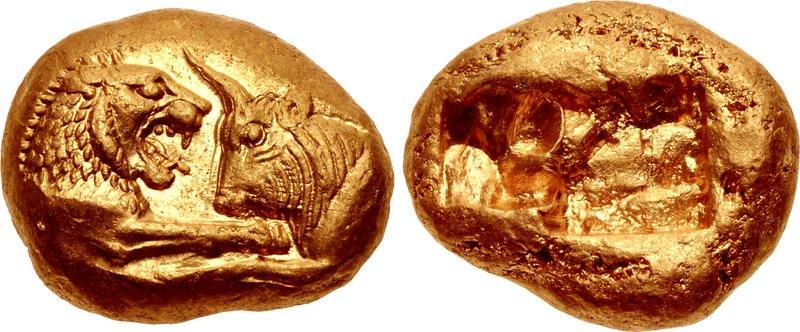
Egypt did not use coins until very late in its history. Value was measured in weights of metals and goods. Gold was mostly controlled by the state and the ruling class, used for jewelry, decoration, gifts and rewards for officials. Coinage came from elsewhere: the kingdom of Lydia, in what is now Turkey. That story is in the first gold coins.
Key dates
| Approximate date | Event |
|---|---|
| Before 3000 BC | Gold worked in the Nile valley |
| Middle and New Kingdom | Large mining expeditions to the Eastern Desert and Nubia |
| 14th century BC | Tutankhamun's burial and its gold treasures |
| About 1160 BC | Turin Papyrus Map drawn |
| 1922 AD | Tutankhamun's tomb found |
Continue the story in gold in the ancient world.