The Klondike gold rush
In 1896 gold was found on a creek in Canada's Yukon. Tens of thousands set out for Dawson City, hauling a ton of supplies over icy mountain passes.
The strike on Rabbit Creek
In August 1896, near the point where the Klondike River meets the Yukon River in northwestern Canada, George Carmack, his Tagish relatives Skookum Jim (Keish) and Dawson Charlie, and others found rich gold on Rabbit Creek. The creek was soon renamed Bonanza Creek. Prospector Robert Henderson had been searching nearby and is also credited with helping to start the rush.
The Yukon was so remote that news traveled slowly. Local miners staked the best claims during the winter. The outside world only learned of the strike in July 1897, when steamships carrying miners and heavy loads of gold arrived in San Francisco and Seattle. Newspaper headlines about a "ton of gold" sparked a stampede.
The stampeders
An estimated 100,000 people set out for the Klondike in 1897 and 1898. Only around 30,000 to 40,000 are thought to have reached Dawson City, and only a small fraction of those found significant gold. The rest turned back, gave up along the way or arrived to find the good claims long gone.
The ton of goods rule
Food in the Yukon was scarce, and winters were brutal. Canada's North-West Mounted Police required each person entering the Yukon to bring roughly a year's worth of supplies, often summarized as a ton of goods. That included flour, bacon, beans, dried fruit, tools, a tent and warm clothing. Stampeders had to carry this load in many trips, relaying it bit by bit up the trails.
The trails
Most stampeders sailed north to the Alaskan coast and then chose a trail over the mountains:
| Route | Notes |
|---|---|
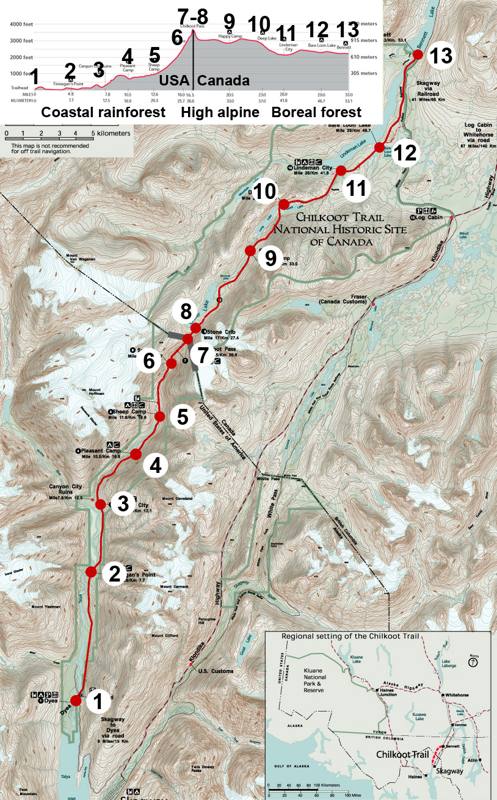
| Chilkoot Trail from Dyea | Short but steep. The final climb to the pass was known as the "Golden Stairs", steps cut into snow and ice. Each person climbed it many times to move their supplies. |
| White Pass from Skagway | Less steep but long and muddy. Thousands of pack horses died on it, and it earned the name "Dead Horse Trail". |
| All-water route | Ship to the mouth of the Yukon River, then steamboat upriver. Easier but expensive and slow. |
After the passes, stampeders built boats and rafts at Lake Bennett and floated more than 800 kilometers down the Yukon River to Dawson City in the spring of 1898.
Mining in permafrost
Klondike gold lay in gravels beneath frozen ground. Miners lit fires to thaw the soil, dug out the thawed gravel and repeated the process day after day through the winter, piling up "pay dirt". In spring, when water flowed, they washed the gravel in sluice boxes to recover the gold. Later, large mechanical dredges took over, and one of them, Dredge No. 4, is preserved as a historic site near Dawson City.
Boom and bust
Dawson City grew quickly into one of the largest towns in western Canada, with theaters, saloons and shops selling goods at extreme prices. Then, in 1899, news of gold on the beaches of Nome, Alaska, drew many people away. The rush faded as quickly as it began.
Legacy
- The Klondike inspired famous writing, including stories by Jack London and poems by Robert W. Service.
- The White Pass and Yukon Route railway was built from Skagway over the pass in a remarkable two-year effort.
- Placer mining continues in the Klondike today, on a much smaller scale.
- The Chilkoot Trail is now a protected historic hiking route shared by the United States and Canada.
Skookum Jim is honored in the Yukon, and Discovery Day, a holiday in the territory each August, marks the 1896 find.
Next, the biggest gold field of all: the Witwatersrand gold rush.