Learn / Famous finds and records
Famous gold discoveries and treasures
From the Varna graves and Tutankhamun's tomb to the Ship of Gold and the hand-dug pit of Serra Pelada, the gold discoveries that made history.
Archaeological gold
The Varna necropolis, Bulgaria (1972)
Workers digging a trench for a cable near the city of Varna uncovered graves dating to roughly 4600 to 4200 BC. The cemetery held thousands of gold objects, making it one of the oldest large collections of worked gold ever found. See gold in the ancient world.
Tutankhamun's tomb, Egypt (1922)
Howard Carter's team found the nearly intact tomb of the young king Tutankhamun in the Valley of the Kings. Its gold mask, roughly 10 kilograms, and the solid gold innermost coffin made it the most famous archaeological discovery of the 20th century. See gold in ancient Egypt.
The Panagyurishte Treasure, Bulgaria (1949)
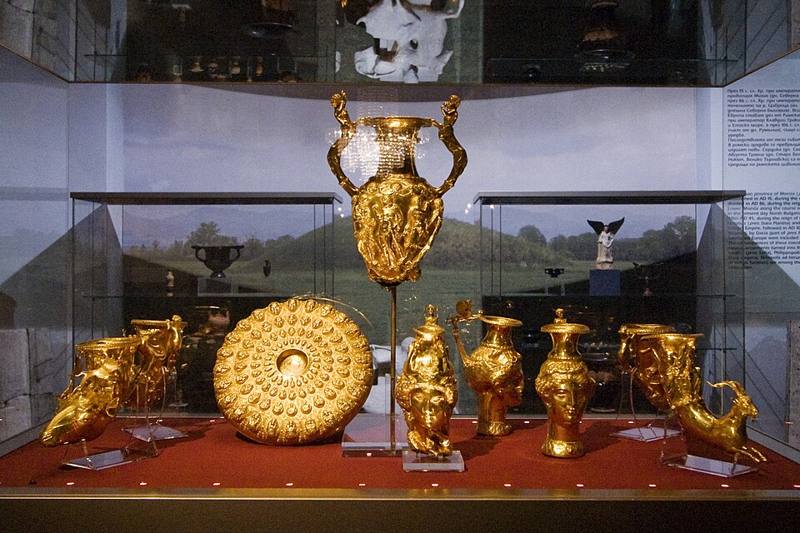
Three brothers digging clay at a tile factory near Panagyurishte found nine gold vessels, including drinking horns shaped like animal heads, weighing about 6 kilograms in total. They date to around the 4th to 3rd centuries BC and are among the finest examples of Thracian goldwork. The treasure has toured museums around the world.
Shipwreck gold
The SS Central America, the Ship of Gold (sank 1857, found 1988)
The steamship SS Central America sank in a hurricane off the Carolinas in 1857 while carrying passengers and a huge cargo of California gold. The loss of the gold contributed to a financial panic that year. In 1988, an expedition using a remotely operated vehicle located the wreck about 2.2 kilometers deep and recovered gold bars, coins and nuggets. Later expeditions recovered more. Many of the assayer's bars from the wreck are famous among collectors.
Spanish colonial wrecks
Spanish fleets carried gold and silver from the Americas across the Atlantic for centuries, and several were wrecked by storms off Florida and in the Caribbean. Recovered wrecks have yielded gold coins, chains and bars, and legal fights over who owns these finds have shaped maritime law.
Gold rush strikes
| Discovery | Year | What followed |
|---|---|---|
| Sutter's Mill, California | 1848 | California gold rush |
| Ophir and Ballarat, Australia | 1851 | Australian gold rushes |
| Witwatersrand, South Africa | 1886 | The largest goldfield ever found |
| Bonanza Creek, Yukon | 1896 | Klondike gold rush |
Modern mine discoveries
The Carlin Trend, Nevada (1961 onward)
Geologists found that northern Nevada held large deposits of "invisible" gold, so fine it could not be seen with the naked eye. Mining began in 1965. With open pits and cyanide leaching, the Carlin Trend became one of the most productive gold regions in the world and turned Nevada into the top gold-producing US state. See open-pit mining.
Muruntau, Uzbekistan (1958)
Discovered in the Kyzylkum Desert, Muruntau became one of the largest gold deposits on Earth and one of the world's biggest open-pit gold mines.
Serra Pelada, Brazil (1980)
After gold was found on a hill in the Amazon region of Para state in 1979 to 1980, tens of thousands of miners rushed in. They dug a huge pit almost entirely by hand, carrying sacks of earth up wooden ladders in scenes made famous by photographers. The site produced large amounts of gold, including the roughly 60-kilogram Canaa nugget (see the largest nuggets), before flooding and safety problems ended the rush in the 1980s and early 1990s.
Lucky finds
- The Hand of Faith (1980, Victoria) was found with a metal detector by a prospector searching near a trailer park.
- Farmers plowing fields and walkers on beaches still occasionally find ancient gold rings, coins and torcs. In many countries, such finds must legally be reported.
Laws on treasure differ widely. In England and Wales, for example, the Treasure Act 1996 requires certain finds to be reported to a coroner. Always check the rules before keeping or selling a find.