The first gold coins, Lydia and electrum
The world's first coins were struck in the kingdom of Lydia, in what is now Turkey, from electrum, a natural gold and silver mix. Pure gold coins followed under King Croesus.
Before coins
For thousands of years before coins, people traded with metals by weight. A merchant would weigh out gold, silver or copper on a balance scale, often in the form of rings, bars, wire or scrap. This worked, but every deal needed scales and trust in the purity of the metal. Someone could mix cheap metal into a bar and it would be hard to tell.
Coins solved both problems. A coin is a piece of metal of a set weight, stamped by an authority that vouches for it. People could count coins instead of weighing metal.
Lydia and the river of electrum
The kingdom of Lydia sat in western Anatolia, in what is now Turkey, with its capital at Sardis. A river near Sardis, the Pactolus, carried flakes of electrum, a natural alloy of gold and silver. Ancient stories linked this river with the legendary King Midas, said to have washed his golden touch away in its waters.
Around the 7th century BC, Lydians (and Greek cities on the nearby coast) began stamping lumps of electrum with marks. The most famous early Lydian coins carry the head of a lion. These are widely considered among the first true coins in the world, and archaeologists have found them in the ruins of Sardis and at other ancient sites in the region.
The problem with electrum
Natural electrum varies a lot. One lump might be 70 percent gold and another only 40 percent, with silver making up the rest. Researchers who analyzed early Lydian coins found that their gold content varied, and they appear to have been made to a standard weight while the metal content was controlled to some degree by the mint. Even so, a coin made of an alloy of uncertain composition makes trust harder. Over time, the solution was to separate the gold from the silver.
Croesus and pure gold
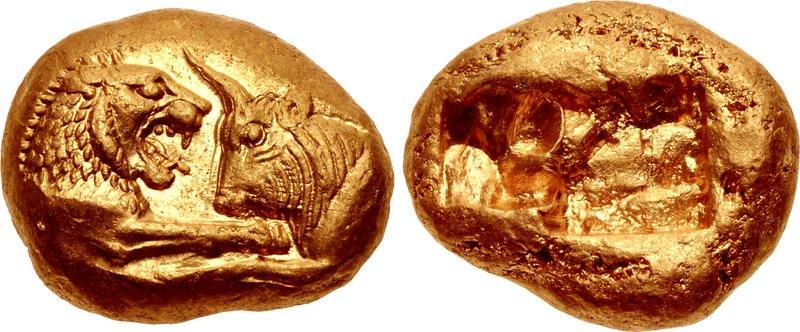
King Croesus of Lydia, who ruled in the 6th century BC, is traditionally credited with the first coinage of separate pure gold and pure silver coins. These coins are called croeseids, and they show the heads of a lion and a bull facing each other.
To make them, Lydian metalworkers had to refine electrum. Excavations at Sardis uncovered a gold refinery where workers used a cementation process: gold was heated with salt in clay vessels, and the salt reacted with the silver, drawing it out of the gold. This left gold of high purity, one of the earliest known examples of large-scale gold refining.
Croesus became so famous for his wealth that "rich as Croesus" is still a common phrase in English.
How coinage spread
After Lydia, the idea of coins spread quickly:
- Greek city-states struck silver coins, such as the Athenian owl, and occasionally gold.
- The Persian Empire, which absorbed Lydia, issued the gold daric.
- Rome later issued the gold aureus, and the late Roman Empire introduced the solidus, a gold coin that stayed in use for centuries.
Why coins matter to gold history
Coins turned gold into money that everyone could use and recognize. A ruler's stamp promised a fixed weight and purity, and the coin's value came from the metal itself. This idea, that money should be backed by or made of a precious metal, shaped monetary systems for more than two thousand years, up to the gold standard and Bretton Woods.
Modern bullion coins such as the American Gold Eagle or the Canadian Maple Leaf continue that tradition, stating their weight and purity on their face. Compare them in our bullion coin comparison.
Timeline
| Approximate date | Event |
|---|---|
| 7th century BC | Electrum coins struck in Lydia and nearby Greek cities |
| 6th century BC | Croesus issues separate gold and silver coins |
| Late 6th century BC | Persian gold daric |
| 4th century AD | Roman gold solidus introduced |