How gold deposits form in the Earth
Gold is spread thinly through the crust. Mineable deposits form where hot fluids, volcanoes or rivers concentrate it, in veins, ancient conglomerates and stream gravels.
Gold is spread thin
The average concentration of gold in the Earth's continental crust is only a few parts per billion. A tonne of ordinary rock contains just a few thousandths of a gram. Mining becomes worthwhile only where natural processes have concentrated gold hundreds or thousands of times above that average. Geologists call such a place an ore deposit.
Even then, most gold is invisible. In many modern mines the ore holds around one gram of gold per tonne of rock or less, scattered as microscopic grains. Visible gold, the kind in nuggets and glittering veins, is the rare exception.
Lode deposits, gold in veins
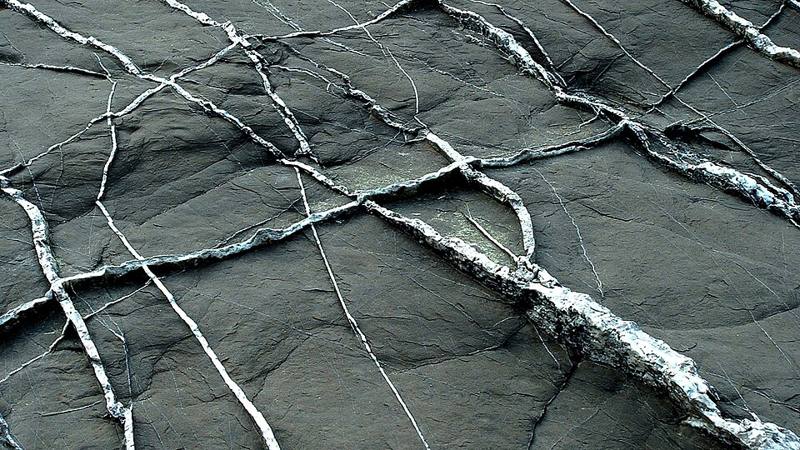
A lode (or primary) deposit is gold still locked in the rock where it formed. The most common type is the quartz vein.
- Water deep underground is heated by magma or by the heat of deep burial.
- The hot fluid, often carrying sulfur and chlorine, dissolves tiny amounts of gold from large volumes of rock.
- The fluid moves up through faults and cracks.
- When pressure, temperature or chemistry change, gold drops out of solution along with quartz and sulfide minerals such as pyrite.
The result is a vein of white quartz that may carry specks or threads of gold. Many of the world's big gold belts, in places such as Western Australia, Ontario and Quebec in Canada, and Ghana, are made of these veins, which formed deep in the crust during mountain building. Other lode types form near volcanoes (epithermal deposits) or within large copper deposits (porphyry deposits), where gold is a by-product.
Placer deposits, gold in gravel
When lode deposits erode, gold is released into soil and streams. Because gold is so dense, it does not wash away like sand. It sinks to the bottom of streams and collects behind boulders, in bedrock cracks and on the inside of river bends. These concentrations are placer deposits, from a Spanish word for a sandbank.
Placers produced most of the gold of the great gold rushes in California, Australia and the Klondike, because a person with a pan or a wooden sluice could recover it. See panning and placer mining.
Ancient river gold, the Witwatersrand
The largest gold deposit ever found is in the Witwatersrand Basin of South Africa. Its gold sits in ancient layers of pebbly rock called conglomerate, about 2.9 to 2.7 billion years old. Geologists still debate whether the gold was laid down by ancient rivers as placers, introduced later by fluids, or both. The basin has supplied a very large share of all the gold ever mined, often estimated at around a third or more. Its story is told in the Witwatersrand gold rush.
Nuggets
A nugget is a lump of native gold large enough to pick up. Nuggets come from eroded veins, and some may grow slightly in soil over time, though scientists still discuss how much. The biggest ever found came from the goldfields of Victoria, Australia. See the largest gold nuggets.
Gold in seawater
The oceans contain gold too, dissolved at extremely low concentrations. The total amount sounds huge when multiplied across all the world's seawater, but every attempt to extract it has cost far more than the gold was worth.
Common deposit types
| Deposit type | How it forms | Typical mining method |
|---|---|---|
| Orogenic quartz vein | Hot fluids during mountain building | Underground or open-pit |
| Epithermal | Hot springs near volcanoes | Open-pit or underground |
| Porphyry | Large magma-related copper systems | Large open-pit, gold as by-product |
| Paleoplacer | Ancient river gravels turned to rock | Deep underground |
| Placer | Modern stream and beach gravels | Panning, sluicing, dredging |
Signs prospectors look for
- White quartz veins, especially rusty ones stained by weathered pyrite
- Black sand (magnetite) in stream gravels, which travels with placer gold
- Old mine workings, which show where earlier miners found gold
Old mine shafts and tunnels are extremely dangerous and often on private land. Never enter abandoned mines, and always check land ownership and local rules before prospecting.