Gold in space
The James Webb Space Telescope's golden mirrors, gold-coated astronaut visors, the Voyager Golden Records and the shiny foil that is often not gold at all. How gold helps us explore space.
Why gold works in space
Space is harsh: intense sunlight, extreme temperatures, radiation and vacuum. Gold has properties that make it valuable there:
- It reflects infrared light extremely well, much better than it reflects blue light.
- It never corrodes or tarnishes, so coatings stay stable for decades.
- It can be applied in very thin, even layers, keeping weight low.
- It conducts electricity reliably, ideal for connectors that cannot be repaired.
The James Webb Space Telescope
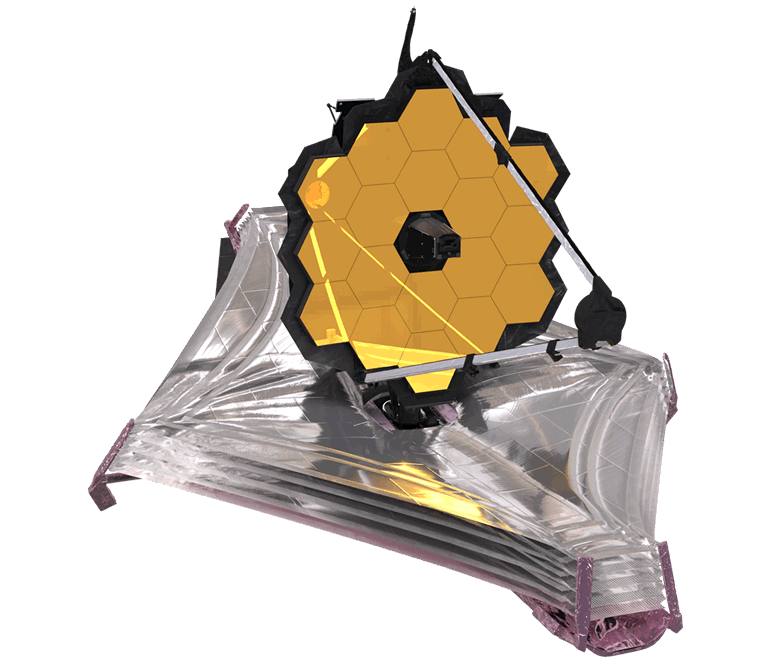
The James Webb Space Telescope, launched on December 25, 2021, has a primary mirror made of 18 hexagonal segments of beryllium, each coated with a microscopically thin layer of gold. NASA has described the coating as about 100 nanometers thick, with a total of only around 48 grams of gold across the whole mirror, roughly the mass of a golf ball.
Webb observes mainly in infrared light, and gold reflects infrared exceptionally well. That makes it the ideal coating for a telescope designed to see the faint heat glow of distant galaxies, forming stars and planets. A thin layer of glass is deposited over the gold to protect it from scratches.
Astronaut visors
The outer visor on astronaut spacesuit helmets has a very thin coating of gold. It is thin enough to see through, but it reflects much of the Sun's infrared and harsh light, helping protect the astronaut's eyes and keep the helmet from overheating. Astronauts can lower or raise the gold visor depending on lighting conditions.
Is the shiny foil on spacecraft gold?
Often not. Many spacecraft and satellites are wrapped in shiny multi-layer insulation, a blanket of very thin plastic films. The gold or amber color usually comes from a polymer film called polyimide (often known by the brand name Kapton), backed with a thin layer of aluminum. It looks like gold foil but contains little or no gold.
"Spacecraft are wrapped in gold foil." Fact: Most of that golden blanket is aluminized polyimide film. Real gold coatings are used where its special properties are needed, such as on mirrors, visors and some thermal surfaces.
The Voyager Golden Records
The two Voyager probes, launched in 1977, each carry a Golden Record: a gold-plated copper phonograph disc with sounds and images from Earth, including greetings in many languages, music and natural sounds. The cover carries instructions for playing it and a map showing the Sun's location. Gold plating was chosen so the records would survive for an extremely long time in space. Both probes have now left the heliosphere, the bubble of solar wind around our solar system.
Gold in satellites and instruments
| Use | Why gold |
|---|---|
| Electrical connectors | Reliable for many years without maintenance |
| Thermal control surfaces | Gold's low emissivity limits heat loss or gain |
| Infrared mirrors and sensors | High infrared reflectivity |
| Wiring and circuits | Corrosion-free contacts |
See gold in electronics.
Gold from space
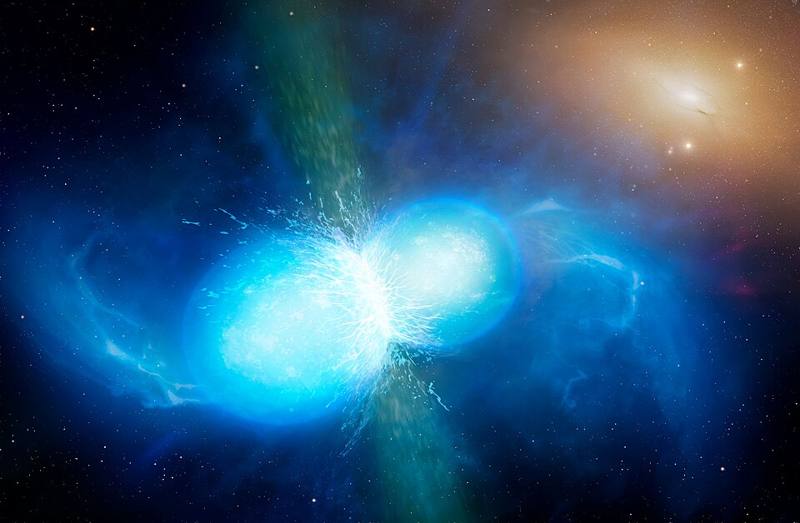
There is a final twist: the gold we send into space came from space in the first place. Scientists believe much of the gold in the universe was formed in extreme cosmic events such as neutron star collisions. See where gold comes from.
The Webb telescope's gold coating is so thin that the gold on the entire mirror would fit in the palm of your hand as a small ball.